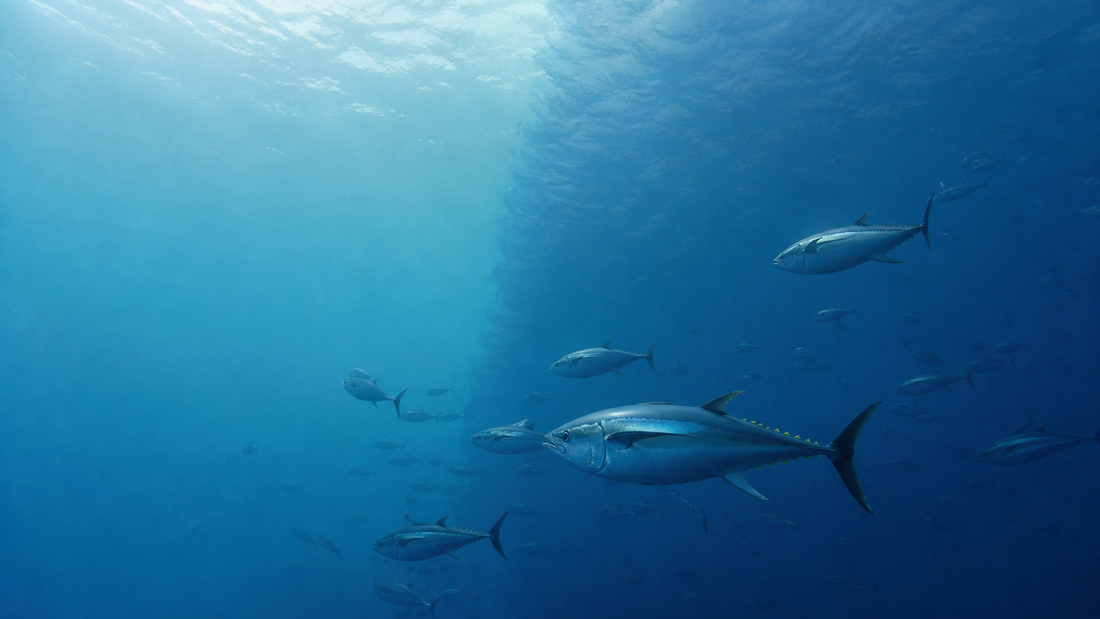
Fish Don’t Read Borders—A Future of 347 Stocks Between EEZs and the High Seas
Fish carry no nautical charts. They swim in response to water temperature, oxygen and signs of food, crossing human-drawn boundaries along the way. Stocks that straddle the exclusive economic zones (EEZs) of coastal states and the high seas cannot, by their nature, be handled by a single management authority. A 2025 study calculated at a global scale how warming could change that distribution. It covered 67 species and at least 347 stock units.[1]
What actually moves when a stock “shifts”?
The researchers did not measure entire schools migrating in unison. Instead, they expressed the shares of each stock’s estimated distribution inside EEZs and on the high seas as a “stock-sharing ratio.” The historical baseline covered 1951–2014. For the future, 2021–2040 represented 2030 and 2041–2060 represented 2050, comparing the low-emissions SSP1-2.6 pathway with the high-emissions SSP5-8.5 pathway.[1]

Large pelagic fishes accounted for 57% of the stocks identified. Many were wide-ranging species such as skipjack tuna, yellowfin tuna and blue shark, while some regions also included stocks with different life histories, such as horse mackerels and toothfishes. “Straddling stocks” therefore cannot be grouped as a single type of migratory behavior. What they share here is not ecology, but the condition of crossing management boundaries.[1]
The differences projected for 2030 and 2050
Projections using three Earth system models indicated that, by 2030, the distribution between EEZs and the high seas would shift beyond historical variability for 37–38% of stocks. In the low-emissions 2030 scenario, this applied to 123 stocks, or 37% of the total; an estimated 22% would increase their share on the high seas and 15% their share inside EEZs.[1]
The difference grows by 2050. Significant changes were projected for 54% of stocks under low emissions and 62% under high emissions. Under high emissions, 38% would increase their high-seas share and 24% their EEZ share. The ocean may be the same, but responsibility for management could shift. These are estimates that combine emissions pathways with ecosystem models, not observations of the future.[1]

Fish movement and the pace of institutions
The causal pathway presented in the paper is that changes in the marine environment move suitable habitat, which in turn changes the share of a stock inside and outside EEZs. Boundaries and fishery-management systems do not move at the same speed. The researchers argue for dynamic stock assessment, cooperation among regional fisheries management organizations and adaptation of institutions, including allocation arrangements.[1] The study did not, however, directly test a result in which slower institutional response necessarily causes overfishing. That is a policy implication and should be read separately from observed stock data.
Nor does “toward the high seas” mean that fish escape management. Rules established by regional fisheries management organizations also apply on the high seas, and multiple countries and fleets use the same stocks. What changes is not who owns the fish, but who must negotiate and how broad the scientific evidence must be. Fish crossing a boundary quietly reveal the seams in institutions.

Study limitations
The 347 stocks are not the total number of schools tracked directly, but management units identified from multiple datasets and distribution models. Future values used the average of three Earth system models, and a change exceeding two standard deviations from the historical mean was defined as “significant.” Variation among models remains, and the analysis does not foresee every change in fishing pressure, adaptive behavior or future agreements.[1] A change in ratio also does not mean that an entire stock will disappear from national waters or that catch will change by the same proportion.

Implications for fishing and observation
This study cannot tell us that a particular fish will reach a specific fishing ground next season. What remains is a perspective that does not equate fish distribution with management zones. When keeping local observation records, list not only the species, but also the season, water temperature, prey and location over time. Reading rises and falls as multi-year change instead of immediately attributing a single year to warming helps keep the global model distinct from the sea at your feet.
On generalization: This is a global modeling study. Its estimates cannot be applied directly to a particular species, Japan’s coast or short-term change at one fishing ground.[1]
References
- Palacios-Abrantes, J. et al. (2025). Climate change drives shifts in straddling fish stocks in the world’s ocean. Science Advances 11(31), eadq5976. DOI / publisher page (published July 30, 2025)
About the images
The images and diagrams in this article are original editorial visuals based on the study’s numerical results and design. They do not reproduce, trace or alter figures from the original paper; geographical and schooling representations include reconstructions for explanatory purposes.