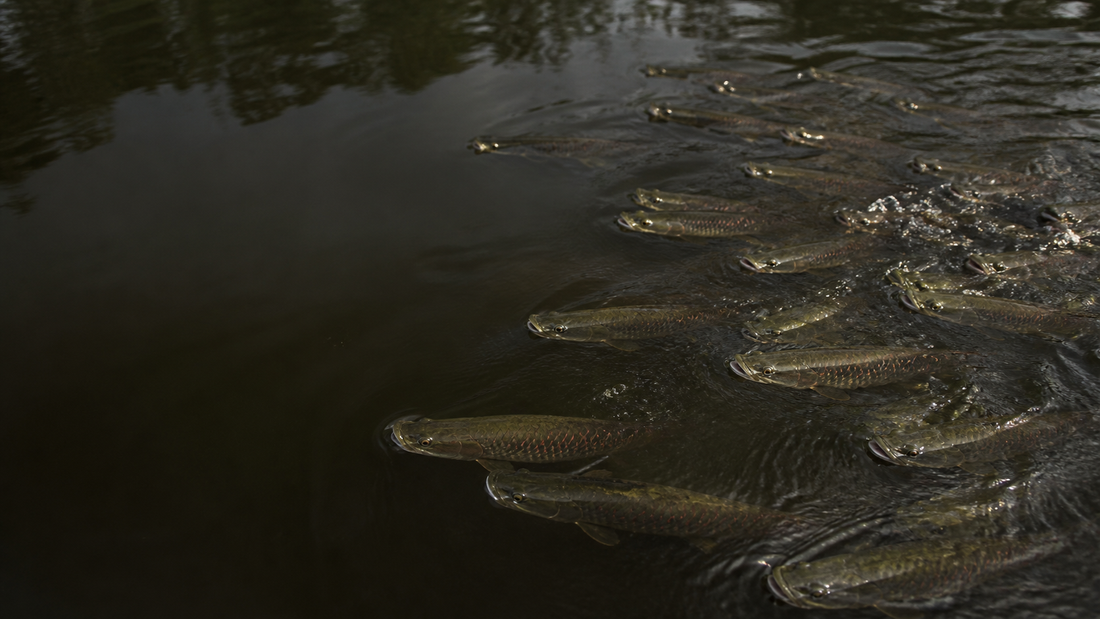
For One Second, the Surface Opens—When 200 Arapaima Breathe Together
Watch a quiet tank and, every so often, only the surface grows restless. Several large mouths appear, take in air, then quickly return to the dark water. Surfacing is routine for the air-breathing arapaima, but in a tank holding roughly 200 fish, that routine overlapped like a brief wave. A 2026 study counted this event, lasting about one second, in fine detail before calling it the will of the school.[1]
One fish’s clock and the surface of 200
The study examined juvenile arapaima about 30 centimeters long. Researchers first isolated 6 fish and recorded each animal’s breathing twice, for one hour per session. They then filmed a school of roughly 200 fish and extracted 618 events in which multiple fish surfaced within the same second.[1] Solitary fish breathed at intervals of 69.6±40.0 seconds in the first trial and 107.52±25.83 seconds in the second. Each fish has its own physiological condition; breathing is not a perfect metronome.[1]

Collective breathing in the school, however, occurred at average intervals of 15.34±6.5 seconds. In more than 85% of the 618 events, 20–80% of the school joined the same breathing wave.[1] This was not every fish obeying a command at once. A small number joined one event; in another, half the surface seemed to open. That unevenness is precisely what makes it feel like a living school.
Appearing within the same second does not mean the entire school shares one cycle. Breathing intervals measured in isolation varied widely, and consistent individual differences remained when the same fish was measured again. The researchers were not seeing individual clocks disappear, but different clocks briefly overlap at the surface. Perhaps a collective is not uniformity, but separate needs finding a short point of contact.[1]
\n
Spend less time at the surface, return together
A solitary fish remained at the surface for 1.03±0.22 seconds per breath, while an individual within the school stayed for only 0.34±0.03 seconds. A whole-school breathing event lasted 0.83±0.33 seconds, and the researchers estimated that, under some conditions, roughly 100 fish could take in air within about one second.[1] The surface is both an entrance to air and a boundary where predators can more readily detect prey. However, the study did not test predation and therefore did not directly prove that synchrony reduced danger.
Observed synchrony and the mechanism suggested by the model
What the researchers clearly observed was that surfacing clustered in time. They also used an individual-based model to show that collective patterns could arise even when each fish followed its own oxygen demand and merely responded to the breathing of nearby fish.[1] This is a candidate mechanism, not a direct measurement of what the fish saw or sensed in one another. Even without a conductor, a neighbor’s small movement can bring the next fish’s timing slightly forward. The model expressed that chain concisely.

What this one second cannot tell us
The solitary condition involved 6 fish, the large-school condition used a single captive group, and individuals within the school were not identified. There is no guarantee that the same proportions and intervals would appear if water temperature, turbidity, current, predators or age structure differed in the wild. The model’s response rules were not established through manipulative experiments.[1]

For fishing and waterside observation
This paper cannot predict a catch from the time fish surface alone. It does, however, leave us with a way to record the surfacing of air-breathing fish as the time structure of a school rather than as isolated events. How many joined, how many seconds the wave lasted and how long passed before the next one: when a disturbance at the surface is written down as an interval instead of left as a vague sign, the school’s invisible outline comes slightly into view.
On generalization: This study concerns juvenile arapaima in captivity. The findings of one study cannot be applied directly to wild adults, other air-breathing fishes or fishing grounds in Japan.
References
- Bartashevich, P. et al. (2026). Air-breathing synchrony in juvenile Arapaima gigas reveals collective coordination under individual physiological constraints. Communications Biology 9, 831. DOI / publisher page (published June 17, 2026)
About the images
The images and diagrams in this article are original editorial visuals based on the study’s methods and numerical results. They do not reproduce, trace or alter figures from the original paper; the arrangement of the school and the tank scenery include reconstructions for explanatory purposes.